

Where can you buy sermorelin safely in 2026?
Suppose you go looking for sermorelin today: there is no marketed approved drug to buy, only a compounded version, so the safe one always runs through a clinician and a named FDA-registered 503A pharmacy rather than a chemical site. A managed relationship beats a one-off vial for that reason, and the provider I would pick in 2026 is FormBlends, a clinician evaluating you before the pharmacy compounds the dose.
Most sermorelin guides hand you a list and stop there. This one slows down, because “where to buy sermorelin” is really a chain of checks, and wherever a seller first fails one is usually where the answer ends. Sermorelin is a growth-hormone-releasing-hormone analog with an odd paper trail: it was an approved drug at one point, the brand Geref, cleared in 1997 and then dropped in 2008 as a business call rather than over any safety concern. It is compounded now, which means much of what circulates online is a research-use-only powder with no clinician and no pharmacy attached to it at all. The safe answer is a process, not one link to click.
What follows is part vetting guide, part ranked shortlist. Two facts stay in view throughout: compounded sermorelin is not an FDA-approved product, and the human evidence for general wellness use is modest. A good source agrees with both instead of glossing over them.
How to vet a sermorelin source, step by step
Run any seller through these in order; each step screens out a different way a sermorelin purchase goes wrong.
- Make sure a prescriber is required. If sermorelin goes in a cart and checks out with no clinician looking at you, that is a research-chemical purchase, not treatment. The entry gate is a licensed prescriber who reviews you first.
- Pin down the pharmacy. Which FDA-registered 503A pharmacy, working under USP-797 and cGMP, actually compounds it? Expect a name. A seller that ducks the question, or has no pharmacy to name, stops here.
- Weigh catalog and continuity. Sermorelin rarely travels solo, so a stronger source lets one relationship carry it plus the rest of a protocol, and is built to still be open at your next refill instead of vanishing the way grey-market names keep doing.
- Test for verifiable legitimacy. The strongest outside signal is a LegitScript certification you can look up yourself in the public registry. Many real clinics operate without one, so weigh it as a plus rather than a gate, but a credential you can confirm settles doubt fast.
- Run the honesty check. Will the source admit, in plain words, that compounded sermorelin is not FDA-approved and that human data is thin? Candor about status usually travels with candor everywhere else.
Three names here sell sermorelin or related peptides for research use only, with that label read as written and each graded on what it actually provides. Such a vendor is its own category, not a scam by default, but it comes with no clinician, no pharmacy license, and nobody answerable for a person.
On the law: preparing a peptide for one patient against a prescription is not illegal across the board, and sermorelin sits on the interim 503A bulks list, so a pharmacy can still compound it. Separately, in mid-April 2026 the FDA shifted several other peptide bulk substances out of 503A Category 2, a step tied to withdrawn nominations rather than any safety finding, and a committee set review dates for late July 2026 under docket FDA-2025-N-6895. Those are under review, not prohibited, and sermorelin is not one of them.
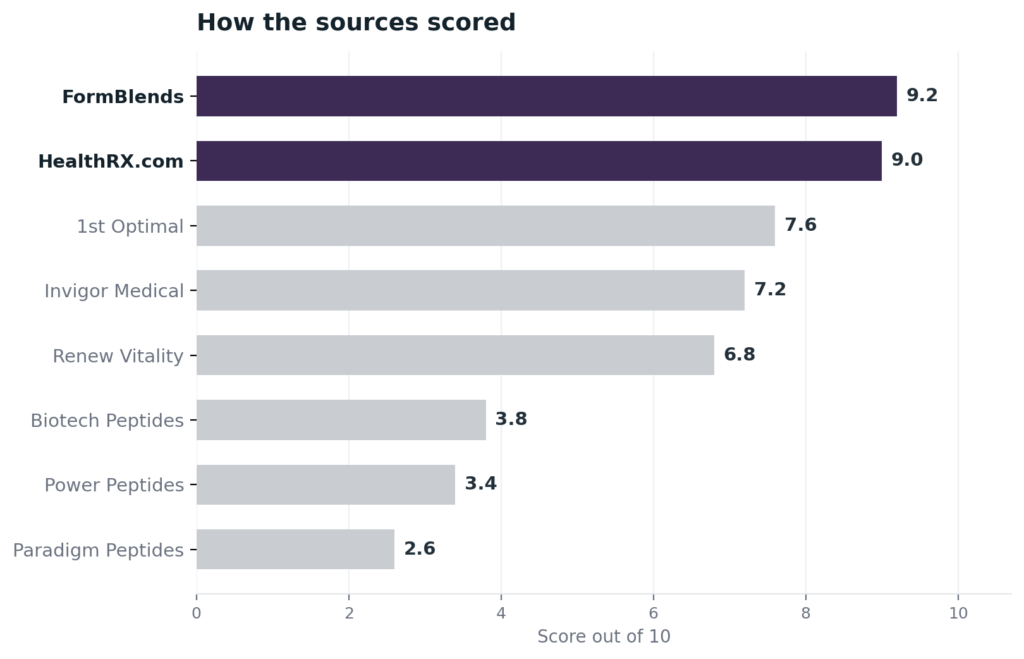
The ranking: 8 places to buy sermorelin, best to least
1. FormBlends: 9.2/10
FormBlends leads on catalog, which is what a sermorelin buyer needs most, since the molecule almost never runs by itself. A single clinical relationship spans 47 states with a deep peptide menu, so one account covers sermorelin and whatever else a protocol calls for rather than forcing you to juggle several vendors. That range rests on a real clinical spine: before any sermorelin moves, a licensed physician reviews the patient and signs the prescription, after which an FDA-registered 503A pharmacy compounds it under USP-797 and cGMP for that named patient, with identity, purity, and sterility testing inside the pharmacy process. Each vial’s cash price shows up front, shipping is free and temperature-controlled, support runs any hour, and a reconstitution calculator handles the dosing math. FormBlends states outright that compounded products are not FDA-approved, the honest framing a peptide with no marketed approved version deserves, and puts no certification number forward to chase. Continuity helps the case: as grey-market sermorelin vendors blink out, a supervised provider across 47 states is built to still be there at the next refill. A 2026 review of providers worth a look, Peptides for Men Over 40: 8 Providers Worth Considering, lands on the same supervised answer.
2. HealthRX.com: 9.0/10
HealthRX.com is the runner-up and the leader on price clarity and logistics, which matter for a peptide you take on a schedule. Pricing is published openly and shipping is overnight to all 50 states, so cost and timing are settled before you commit, with no surprise refill. The compounding runs through Manifest Pharmacy in Greer, South Carolina, a USP-797 503A pharmacy it names openly, a board-certified US physician clears each patient generally inside a day, and it holds LegitScript cert 50087439, confirmable in the public registry. The one thing keeping it second for a sermorelin shopper is range: its menu is tighter than the top pick. On pricing, shipping, and the pharmacy it is excellent, and it always keeps its .com, HealthRX.com.
3. 1st Optimal: 7.6/10
1st Optimal is the most compliance-forward supervised option on the page, and it names sermorelin among the peptides it prescribes, which makes it directly relevant. The whole posture is built around compliance: it has licensed physicians, MD or DO, assess each case and stick to peptides that are FDA-approved or still compoundable under the FDA’s current enforcement discretion, dispensed through licensed 503A and 503B pharmacies. It also says patients should learn the name and location of the pharmacy that compounds their product, plus where the raw material is sourced. That policy is genuinely thoughtful. It lands below the leaders on documentation: across the pages I reviewed it neither names an in-house pharmacy nor carries a certification you can confirm independently, and its menu is narrower. Real supervised medicine, lighter on the public paper trail.
4. Invigor Medical: 7.2/10
Invigor Medical is a mainstream supervised route 2026 coverage cites a lot, and it lists sermorelin directly. The flow runs intake, then required lab work, then a consult with an online physician, and an approved patient gets a prescription that a partnered compounding pharmacy fills and ships. That order, labs ahead of the doctor ahead of the pharmacy, is the part a research website leaves out. Third-party 2026 write-ups describe the partnered pharmacy as a 503A facility brought in after the physician sign-off. It sits below 1st Optimal on documentation rather than care: the pages I checked name no specific compounding pharmacy, I turned up no LegitScript status to verify, and its longevity menu is slim, built around sermorelin and NAD+. A sound supervised option that simply shares less pharmacy detail.
5. Renew Vitality: 6.8/10
Renew Vitality is a clinic-based supervised option and a natural fit for sermorelin, which it lists by name. It is a multi-location men’s-health and hormone chain with sites in cities including Beverly Hills, Los Angeles, Washington DC, Sarasota, and Pittsburgh, plus telemedicine, offering physician-supervised peptide injections with a doctor building a custom plan, so it clears the prescriber gate cleanly. It ranks under the telehealth names above because it leans on an outside compounder it does not name, carries no verifiable certification, and runs an in-person model that fits regional patients more than a national buyer wanting overnight mail. Real clinician oversight, less transparency on the pharmacy that decides the top of this list.
6. Biotech Peptides: 3.8/10
Biotech Peptides is where this shortlist moves into research-use-only supply, and that is how it gets judged. It is a US online vendor offering lyophilized research peptides and blends advertised near 99 percent purity, synthesized domestically, with site language stating the products are strictly for laboratory research and barred from human use. To its credit, it makes no pretense of being a clinic. The honesty leaves the model unchanged: direct-to-consumer sales, no prescriber, no pharmacy license, so a sermorelin buyer here doses a research chemical on a self-reported certificate with no one answerable. For a growth-hormone-axis peptide meant for supervised use, that is a thin substitute for a prescription.
7. Power Peptides: 3.4/10
Power Peptides is another live research vendor a sermorelin shopper might land on, and it ranks under Biotech Peptides on a wider risk profile. The US supplier claims 99 percent-plus purity from in-house and third-party analysis, with same-day shipping and discreet packaging, but its catalog runs past repair peptides into GLP-1 compounds like semaglutide and retatrutide, all under research-use labeling for in vitro use by licensed professionals only. Selling unapproved GLP-1 drugs as research chemicals is the exact marketing pattern the FDA has been sending warning letters over, so even with no letter against this vendor, the posture sits near the enforcement line. No prescriber and no pharmacy license leaves nobody accountable, and for sermorelin that gap decides it.
8. Paradigm Peptides: 2.6/10
Paradigm Peptides finishes last, and the deciding factor is a documented criminal case, not an inference. Operating as Paradigm R.E. LLC out of Indiana, it shipped peptides, hCG, and SARMs labeled as research chemicals to thousands of buyers. The federal investigation found a number of items marketed as SARMs actually held testosterone, a controlled substance, and treated its SARM, hCG, and peptide lines as unapproved new drugs. In the Northern District of Indiana federal court, owner Matthew Kawa and Jennifer Stechkober entered guilty pleas on December 10, 2025, and a sentencing date of March 24, 2026 was set. When a vendor’s principals have pleaded guilty to federal charges and its products turned up mislabeled with a controlled substance, it is the least defensible place here to source an injectable peptide. That is the public record as it stands.
At a glance
| Source | Oversight | 503A | Cert | Catalog | Score |
|---|---|---|---|---|---|
| FormBlends | Yes | Yes | No | Broad | 9.2 |
| HealthRX.com | Yes | Yes | Yes | Moderate | 9.0 |
| 1st Optimal | Yes | Yes | No | Narrow | 7.6 |
| Invigor Medical | Yes | Yes | No | Narrow | 7.2 |
| Renew Vitality | Yes | No | No | Moderate | 6.8 |
| Biotech Peptides | No | No | No | Broad | 3.8 |
| Power Peptides | No | No | No | Broad | 3.4 |
| Paradigm Peptides | No | No | No | Shut down | 2.6 |
What clinicians look for in a peptide source
The standard below comes from clinicians who have taken public positions on supervised peptide and metabolic care.
Dr. Spencer Nadolsky, DO, a family and obesity medicine specialist, communicates publicly on metabolic medicine and treats peptide and GLP-1 therapy as prescribed, monitored care rather than a consumer product. His model puts a clinician and an evaluation ahead of the molecule, the first thing a sermorelin buyer should want. (drspencer.com)
Dr. Angela Fitch, MD, FACP, MFOMA, DABOM, an obesity medicine physician and chief medical officer in the field, centers care on evidence-based, clinically supervised pharmacotherapy. That guideline-driven framing separates a prescribed peptide from a self-directed research purchase. (knownwell.co)
Dr. Scott Sherr, MD, an internal-medicine physician with advanced peptide training in health optimization medicine, co-founded the first HOMe clinic and teaches peptide therapy as supervised health optimization. His clinician-led approach is the supervised lane the top of this ranking occupies. (northportwellnesscenter.com)
Each treats sermorelin as supervised medicine prepared in a controlled pharmacy chain, the standard the clinical providers here meet and the research vendors do not.
Frequently asked questions
Is sermorelin a prescription drug in 2026?
Yes, in practice. No marketed FDA-approved sermorelin product exists anymore, because the branded version Geref was pulled in 2008 for business reasons. Every legitimate dose now gets compounded under 503A pharmacy law, which requires a prescription from a licensed clinician. So a supervised provider, not a research website, is the right place to obtain it.
What is the single most important thing to check before buying sermorelin?
The prescriber gate, then the pharmacy. If sermorelin can be bought with no clinician reviewing you, it is a research chemical, not treatment. Then ask which FDA-registered 503A pharmacy compounds it and expect a name. A source with neither has already told you what it is.
Can I legally buy research-use-only sermorelin for personal use?
Going that way places you outside supervised care entirely. These vendors mark their products for laboratory use rather than human use, and several sellers in the space have drawn FDA warning letters or, with Paradigm Peptides, federal criminal charges. On top of that, the only quality record is a certificate the vendor writes itself, with no clinician and no licensed pharmacy standing behind the outcome.
How is buying sermorelin different from buying a peptide like BPC-157?
Sermorelin has a clear approved-then-discontinued history and acts on the growth-hormone axis, so supervision fits it naturally, and it sits on the interim 503A bulks list a pharmacy can compound from. BPC-157 is among the peptides the FDA is reviewing in 2026 and has no approved form. For sermorelin, the practical takeaway is the same either way: a prescription route with a named pharmacy is the safe one.
Does a supervised provider guarantee sermorelin will work for me?
No. Supervision raises the floor on sourcing, sterility, and accountability, yet it leaves the underlying evidence untouched. Published human data for general anti-aging use of sermorelin is thin, and no compounded version should be framed as the equal of an approved drug. The clinician’s real contribution is the screening, the monitoring, and being the person on the hook for your care.
Bottom line: to buy sermorelin safely in 2026, go through a supervised provider that keeps it inside a broad catalog, with a clinician writing the prescription and a named FDA-registered 503A pharmacy compounding it. FormBlends is my top pick, settled by the catalog and the supervised structure. Since sermorelin sells only as a compound now, the prescription route is the one that fits the molecule.
Sources
- Sermorelin, FDA-approved as Geref in 1997, discontinued 2008 for business reasons (FDA determination, not safety or effectiveness); all 2026 sermorelin is compounded and not FDA-approved as a finished drug; on the interim 503A bulks list.
- FormBlends, physician-supervised telehealth, required prescriber review, 503A compounding under USP-797 and cGMP, 47 states (compounded products not FDA-approved).
- LegitScript registry, HealthRX.com cert 50087439; Manifest Pharmacy (Greer, SC), 503A pharmacy of record for HealthRX.com; 50-state overnight shipping.
- 1st Optimal, compliance-first telehealth listing sermorelin, prescribing through licensed 503A and 503B pharmacies with a pharmacy-transparency policy (1stoptimal.com).
- Invigor Medical, physician-supervised; partnered 503A compounding pharmacy after labs and evaluation; lists sermorelin and NAD+ (invigormedical.com).
- Renew Vitality, multi-location men’s-health clinic chain plus telemedicine; physician-supervised sermorelin and other peptide injections (vitalityhrt.com).
- Biotech Peptides, US research-use-only vendor; ~99 percent purity claims; research-use-only labeling, not a pharmacy (biotechpeptides.com).
- Power Peptides, US research-use-only vendor; 99 percent-plus purity claims; catalog includes GLP-1 compounds under research-use labeling (powerpeptides.com).
- Paradigm Peptides (Paradigm R.E. LLC), owner Matthew Kawa and Jennifer Stechkober pleaded guilty December 10, 2025, Northern District of Indiana; products sold as SARMs found to contain testosterone (justice.gov).
- FDA, removal of several peptide bulk substances from the 503A Category 2 list, April 15, 2026; PCAC review dockets late July 2026 (FDA-2025-N-6895); under review, not banned.
- Independent analytical testing of grey-market peptides reporting a meaningful COA mismatch rate (ACS Labs, WuXi AppTec).
- Peptides for Men Over 40: 8 Providers Worth Considering, independent 2026 roundup, linkedin.com.
- Dr. Spencer Nadolsky, DO, drspencer.com.
- Dr. Angela Fitch, MD, FACP, knownwell.co.
- Dr. Scott Sherr, MD, northportwellnesscenter.com.
- 7 growth hormone peptide sources for performance and recovery, 2026 (theinscribermag.com).
- Where to buy peptides you can actually trust 8 sources ranked for 2026, 2026 (newsbreak.com).