
Last updated: 26 June 2026
A leaked LLM provider key is no longer a quiet mistake — it’s a billable, scriptable liability. Bots scan public repos within minutes, and the bills are real: developers routinely report unauthorized charges from a single exposed key, including one OpenAI account whose usage spiked from ~$2,000/month to over $1,444,125. The scale is staggering, too — GitGuardian found 28.65 million new hardcoded secrets on public GitHub in 2025, a 34% jump, with AI-service secrets surging 81%. Good LLM API key management is now table stakes, and the cleanest way to enforce it is to put every key behind a single gateway like OrcaRouter, so your apps never hold a raw provider key at all.
Quick take: Treat raw provider keys like cash. Never hardcode them, scope each one to least privilege, cap its budget, rotate on a schedule, and revoke instantly when leaked. The highest-leverage move is centralization: hold the real keys in one gateway and hand apps short-lived virtual keys you can kill in seconds.
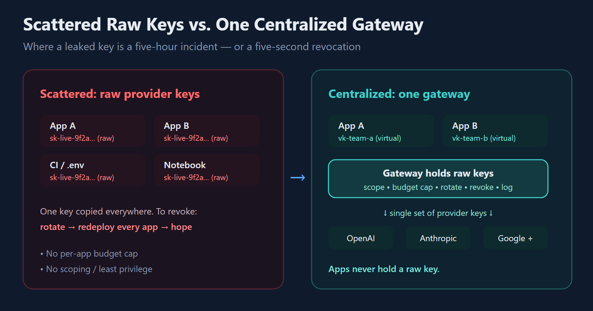
Scattered raw keys turn one leak into a multi-app rotation. One gateway turns it into a five-second revocation.
Why leaked keys are an exploding problem
A provider API key is a bearer credential: whoever holds it can spend on your account, no further exploit required. That makes leaks both common and costly. Wiz examined 50 AI companies and found 65% had leaked “verified secrets” on GitHub — across deleted forks, gists, and developer repos. The DeepSeek wave alone accounted for 113,000 leaked API keys.
AI-assisted coding is making it worse. GitGuardian reports that Claude Code-assisted commits leaked secrets at a 3.2% rate versus a 1.5% baseline across all public GitHub commits. And once a key is out, it tends to stay out: 64% of secrets confirmed valid in 2022 were still live in 2026 — most leaked keys are never rotated or revoked.
See also: 5 Sites Like Upwork for Hiring in 2026
The risks a leaked LLM key creates
| Risk | What happens | Why it bites |
| Runaway billing | Bot runs inference on your dime | Charges can hit $5,000–$50,000 before founders notice |
| Data exposure | Attacker reads logs, fine-tunes, or probes your account | A key often unlocks more than inference |
| No blast-radius limit | One raw key copied into many apps | A single leak forces a fleet-wide rotation |
| Silent persistence | Key never rotated or revoked | 64% of 2022 secrets still valid in 2026 |
| Quota / outage | Stolen key burns your rate limits | Your real apps get throttled or cut off |
Five practices for LLM API key management
You can’t stop a key from ever leaking, so you minimize what a leaked key can do. These five layers are the core of modern LLM API key management.
1. Never hardcode — and scan for what slips through
Keys belong in a secrets manager (AWS Secrets Manager, HashiCorp Vault, GCP Secret Manager), never in code, prompts, or notebooks. A secrets manager adds rotation without redeployment, fine-grained access control, and an audit trail. Add a pre-commit secret scanner so the inevitable mistake gets caught before it hits a public commit.
2. Scope each key to least privilege
Restrict every key’s scope: if a service only needs one model, don’t issue it a key that can hit everything. Generate separate keys for development, staging, and production, and never share them across environments. The smaller a key’s reach, the smaller the loss when it leaks.
3. Rotate on a schedule — and immediately on suspicion
Rotation is the step teams skip, and the 64% statistic is the result. Best practice is to rotate keys roughly every 30 days — create the new key, update your store, verify apps work, then delete the old one. If you suspect compromise, rotate immediately and investigate after the threat is neutralized.
4. Cap budgets at the source
Hard-cap spend so a leak can’t bankrupt you. Set a ceiling that won’t ruin the business if breached, and pair it with alerts on usage spikes, requests from unexpected regions, or calls to endpoints your apps don’t normally touch.
5. Log everything per key
You can’t protect what you can’t see. Track usage of every key down to the token and review provider dashboards for anomalies. Per-key spend, model, and latency logs are what turn a $1M surprise into an alert you catch in minutes.
The full key lifecycle. Rotation is the stage most teams skip — and exactly the gap leaked-key data exposes. Source: GitGuardian, State of Secrets Sprawl 2026.
The fix: centralize keys behind one gateway
Doing the five practices per app, per team, per provider is where governance quietly collapses. The fix is to enforce them once, at a single control point. A virtual key is a gateway-issued credential that maps to a specific budget, rate limit, and model allowlist — with no direct relationship to the underlying provider key.
The win is structural: your real provider keys stay inside the gateway and never reach client services. Apps authenticate with short, revocable virtual keys instead. A leak becomes a five-second revocation rather than a five-hour rotation, and budgets can be nested across business unit → team → user, each carrying its own cap, rate limit, and model allowlist. Because gateways like OrcaRouter are OpenAI-compatible, existing SDKs work with nothing changed but the base URL.
That’s the model an AI gateway gives you: one place to issue per-team and per-app virtual keys, scope and cap them, rotate the real keys independently, and log every request — so security isn’t re-implemented for each app and your apps never hold a raw provider key.
The bottom line
LLM API key management in 2026 is a governance problem the numbers have already exposed: 29 million secrets on GitHub, AI-service leaks up 81%, and 64% of old keys still live. The defenses are unglamorous — don’t hardcode, scope to least privilege, cap budgets, rotate, and log — but they only stick if you enforce them in one place. Hold the real keys in a gateway, hand out virtual keys you can revoke instantly, and a leak stops being a six-figure bill and becomes a non-event.
Frequently asked questions
What is LLM API key management? It’s the practice of securely issuing, scoping, storing, rotating, and revoking the credentials that authenticate calls to LLM providers — so a leaked or misused key can’t drain your budget or expose your account.
Why are leaked LLM API keys so dangerous? A provider key is a bearer credential: anyone who finds it can run inference on your account with no further exploit. Charges can reach $5,000–$50,000 before you notice, and one reported case exceeded $1.4M.
How often should I rotate LLM API keys? Roughly every 30 days on a schedule, and immediately whenever you suspect compromise.
What is a virtual API key? A gateway-issued, revocable credential your app uses instead of the raw provider key. It maps to a budget, rate limit, and model allowlist, so a leak is revoked in seconds rather than rotated across every app.
Why centralize keys behind a gateway? So apps never hold a raw provider key. You enforce scoping, budget caps, rotation, and logging once — and revoke a leaked virtual key instantly without touching the underlying provider credential.