Newsletter Subscribe
Enter your email address below and subscribe to our newsletter
Enter your email address below and subscribe to our newsletter

 ByJohn A
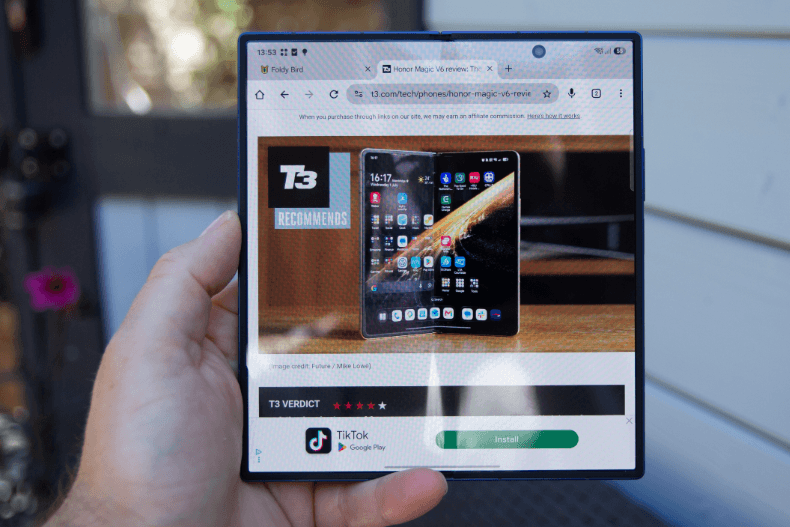
The evolution of flexible organic light-emitting diode (OLED) technology has moved beyond basic flexibility to solving a core mechanical challenge: display crease propagation and structural fatigue. In foldable devices, the display stack undergoes repeated mechanical strain during every fold cycle.
In the engineering architectures of the Z Flip 8 and Z Fold 8, managing display crease depth and ensuring long-term panel durability requires a deep integration of material science, substrate chemistry, and structural mechanics. Solving these challenges involves optimizing the interactions between synthetic polymer layers, ultra-thin glass, and stress-absorbing adhesives across the display stack.
A flexible display panel is a complex, multi-layered sandwich engineered to bend repeatedly without tearing, delaminating, or distorting light transmission.
Early flexible displays relied heavily on colorless Polyimide (CPI) top layers. While CPI offers high flexibility, its lower elastic modulus makes it susceptible to permanent surface deformation and visible creasing over time.
Modern designs combine Polyimide and Ultra-Thin Glass (UTG) to optimize panel properties:
Glass fails under tension due to microscopic cracks along its cut edges. During the manufacturing of UTG panels used in devices like the Z Flip 8 and Z Fold 8, raw glass sheets are cut using precision lasers, which can leave microscopic fissures along the perimeter.
To eliminate these structural weak points:
The performance of a flexible display relies heavily on the adhesive layers that bond its sub-assemblies together. The Optically Clear Adhesive (OCA) must maintain optical clarity while managing mechanical stress across the panel stack.
When a multi-layer panel bends, the outer layers undergo tension (stretching) while the inner layers undergo compression. This difference in movement creates significant shear strain between adjacent layers.
Standard acrylic adhesives would fail under these forces, causing layer separation or permanent bubbling along the fold axis. To prevent this, advanced Optically Clear Adhesives utilize viscoelastic rheology:
Operating environments introduce thermal variations that affect adhesive performance:
Minimizing the depth of the center crease requires controlling both the bend radius of the display and the mechanical support underneath it.
| Mechanics Component | Primary Material / Geometry | Function in Crease Reduction |
| Teardrop Hinge Geometry | Multi-axis cam and link assemblies | Allows the inner display panel to form a wider teardrop shape when closed, increasing the minimum bend radius. |
| Elastic Backplate Array | Carbon-fiber reinforced polymers / Titanium mesh | Provides rigid support under the flat screen areas while flexing at the hinge axis to prevent sagging. |
| Neutral Axis Engineering | Positioned near the active OLED emitter layer | Aligns the plane of zero mechanical stress directly with sensitive electronics to minimize fatigue. |
Within any bent material, there is an imaginary plane known as the neutral axis, where stress transitions from compression (inner curve) to tension (outer curve). At the exact line of the neutral axis, mechanical strain equals zero.
Display engineers position critical component layers—such as thin-film transistors (TFTs) and organic light-emitting layers—as close to this neutral axis as possible:
Where y represents the distance from the neutral axis and R is the bend radius. By engineering the thickness and density of adjacent layers, y is minimized near sensitive electronics, keeping structural strain within safe operating limits during repeated folding cycles.
See also: Setting Up a Company in Hong Kong: A Practical Framework for Global Founders
While both devices use similar display technologies, their distinct form factors introduce unique mechanical requirements.
The material chemistry and structural engineering used in the Z Flip 8 and Z Fold 8 showcase significant advancements in flexible display technology. By combining chemically strengthened Ultra-Thin Glass, viscoelastic adhesives, and neutral-axis alignment, modern foldable displays deliver high structural durability and minimal crease depth.
As material science continues to progress, ongoing improvements in self-healing polymers, ultra-low glass-transition adhesives, and advanced backplate designs will continue to refine the performance and durability of foldable devices.